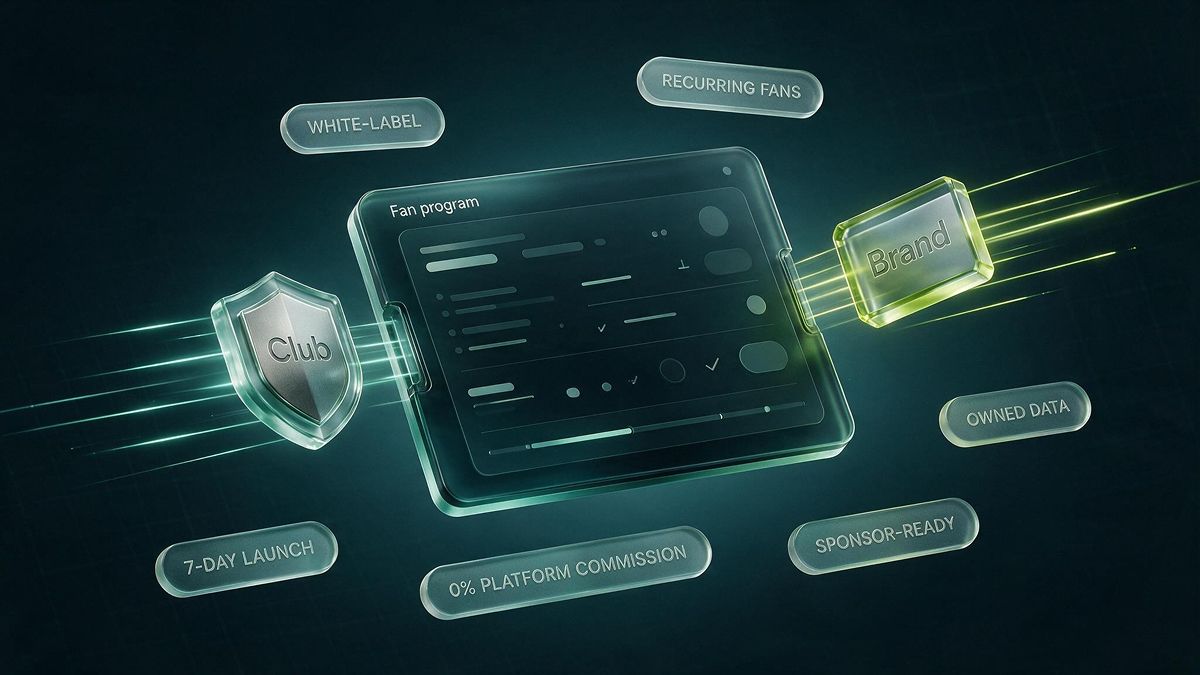
A one-off esports tournament buys attention for a weekend. A recurring fan program converts that attention into registered fans, first-party data, sponsor-ready inventory and revenue that repeats every season. The tournament is the entry point; the program is the business model.
This guide addresses the two audiences facing that decision: marketing, events and innovation leaders at football and basketball clubs, and brand teams responsible for activations, sponsorships and campaigns. It explains why esports tournaments earn Gen Z attention, which of three formats fits your objective, how to run the first edition, and what changes operationally and financially when you commit to seasons and an always-on platform.
Why sports clubs and brands run esports tournaments
The commercial case rests on audience overlap and documented buying behavior. According to 2026 platform data compiled by Instreamly, 87% of Gen Z consumers aged 13 to 24 play video games regularly. The same cohort represents 43% of the global esports audience, and the esports market is projected to grow from $4.5 billion in 2026 to $30.7 billion in 2036, an annual growth rate of 21.1%.
Gaming attention converts. GamesBeat reports that 74% of Gen Z say a brand's activity in gaming influences their purchase decisions. A study covering 400 million esports fans found that 66% had bought a product after a collaboration or co-branding between a team and a brand. Sponsorship performs inside the medium as well: 43% of esports fans describe sponsors as essential, 35% notice sponsor logos and 29% say they are more likely to buy from sponsoring brands.
Clubs use tournaments to reach young supporters who may never enter a stadium. FC Barcelona opened an eFootball section in 2016. Paris Saint-Germain launched PSG Esports the same year and has fielded Dota 2 and football simulation rosters. Beşiktaş has run a club esports section since the early 2010s. In each case, competitive gaming extends the club badge into digital spaces where younger fans already spend their time.
Brands gain something standard media placements cannot provide: named participants and consented contact details from people who actively opted in to compete. Between 51% and 54% of Gen Z say gaming content increases their engagement with both brands and traditional sports, which makes a club-and-brand pairing around a tournament commercially legible on both sides.
The infrastructure signal matters too. The sports fan engagement platform market is forecast to grow from $4.8 billion in 2025 to $13.2 billion in 2034, a CAGR of 11.9% (Dataintelo). Clubs and brands are building persistent programs, not running isolated experiments.
Three formats: one-off tournament, recurring series, always-on platform
Most organizations start with a one-off tournament because it is quick to approve and easy to scope. The limitation appears after finals day: the audience disperses, the data sits in a spreadsheet and sponsors have nothing concrete to renew. The three formats below differ in commitment level and in what they leave behind.
| Format | Shape | Typical cycle | Primary objective | What remains afterwards |
|---|---|---|---|---|
| One-off tournament | Single bracket, online or with a live final | 8 to 12 weeks end to end | Awareness spike, product launch, first data test | Contact list, highlight content |
| Recurring series | Seasons of qualifiers leading to finals | Quarterly or seasonal | Community retention, sponsor renewals, storylines | Registered player base, historical standings |
| Always-on platform | Branded hub with ladders, events, profiles and content | Year-round | Owned audience, monetization, sponsor inventory | Compounding first-party data and recurring revenue |
Selection guidance: if the goal is a campaign burst tied to a launch date, run a one-off and treat it as a paid pilot. If the goal is keeping a community active between flagship moments, commit to a series with fixed season dates. If the goal is an owned audience that generates revenue without a new campaign each quarter, operate a platform and schedule tournaments inside it. Budget follows the same logic: a one-off is a project cost, a series is a program cost and a platform is an infrastructure cost.
How to run it: the playbook
Choose the game and format
Start from the audience you already have. Football clubs typically begin with football simulation titles such as EA Sports FC or eFootball, because the connection to the parent sport is immediate. Basketball clubs apply the same logic with basketball simulations. Add a second, broader title once registration volume matters more than thematic purity. For format, individual 1v1 brackets are the simplest to administer and scale cleanly into large entry fields; team formats generate richer content but require roster verification and coordinated scheduling.
Plan 8 to 12 weeks ahead
The detailed timeline is at the end of this section (the launch plan, around 120 days). This is the same calendar; keep the operative horizon in mind and work backward from the finals date.
Pre-launch checklist:
- Confirm publisher licensing terms and platform restrictions for the chosen game
- Define age ratings and eligibility rules, including parental consent where required
- Fix the prize structure, payout method and tax responsibilities
- Approve data consent wording and the storage location for registration records
- Publish a code of conduct, moderation policy and dispute procedure
- Book broadcast rights and confirm caster availability
- Set backup dates for postponements
- Assign administrator coverage for every qualifier round
Staff a small core team
Four roles cover most editions. A project owner holds the budget, the calendar and internal approvals. Tournament administrators run check-ins, verify results and resolve disputes. A content lead produces announcements, standings posts and recap material. A broadcast lead owns the stream, from a single-caster feed up to staged production. Design, moderation overflow and translation are freelance capacity added per edition.
Handle logistics for online, offline and hybrid editions
Online-only events reduce logistics to platform configuration, admin coverage across time zones and one tested communication channel. Hybrid and offline finals add venue booking, hardware, player travel and accreditation. When a live final is part of the plan, specialist support pays for itself: our gaming event services cover venue production, player management and on-site operations for exactly this layer of a program.
Set up the broadcast
The minimum viable broadcast pairs gameplay footage with two casters and an overlay showing scores, brackets and standings. Overlays fed directly by live tournament data remove manual score graphics and cut errors. Multi-camera stage productions with player interviews and analyst desks raise production value and expand sponsor inventory; our live production team handles that tier, from camera plans to stream distribution.
Write rules that protect players and the brand
A usable ruleset covers competition integrity and participant welfare. Integrity means accepted game versions, allowed settings, proof-of-result requirements and defined penalties for cheating. Welfare means scheduled breaks, age-appropriate scheduling, a named contact for harassment reports and GDPR-compliant handling of personal data. Publish the document before registration opens and version every change; mid-season rule edits destroy trust faster than any technical failure.
Match day: the practical rules
On match day the run sheet governs everything. Build it minute by minute from admin check-in to the closing stream segment, assign an owner to each block and circulate it to staff, casters and sponsors. Two operating rules prevent most disputes.
Reschedule requests must arrive at least 72 hours before the scheduled start. Later requests are granted only at administrator discretion, which protects the broadcast schedule and the opposing team.
Players and teams receive a 15-minute grace period from the scheduled start time to check in. After 15 minutes the match converts to a forfeit. State both rules in the ruleset, repeat them in every round email and enforce them identically in qualifiers and finals.
Close each match by recording the verified result in the platform immediately, collecting screenshots from both sides and timestamping any dispute. Same-day publication of results keeps standings credible and hands content teams fresh material while attention peaks.
The launch plan (around 120 days)
The timeline below moves from decision to delivered first edition. It assumes online qualifiers with an online finals format.
| Days | Phase | Duration | Milestones |
|---|---|---|---|
| 1 to 7 | Scoping | 7 days | Objectives, budget, KPI baseline, game and format selected, rulebook drafted, core team assigned |
| 8 to 47 | Sponsors | 40 days | Outreach, negotiation, agreements signed, legal approvals. Duration varies with the relationship: an engaged partner signs in weeks, cold prospecting can take two months |
| 48 to 57 | Announce and register | 10 days | Public announcement, registration open, teaser content running, admins and casters booked |
| 58 to 97 | Qualifiers | 40 days | Qualifier rounds completed, weekly standings published, registrant database growing, on-air assets for the finals produced |
| 98 to 104 | Finals preparation | 7 days | Finals bracket generated, broadcast rehearsed, run sheet validated |
| 105 to 111 | Finals and review | 7 days | Finals delivered, recap content shipped, sponsor performance report sent, season two parameters agreed |
The breakdown totals around 111 days; the sponsor phase is the variable (40 days planned, sometimes more), which is why the practical horizon is the 120-day window. If you already have sponsors lined up, the calendar compresses.
The final day should end with a decision rather than a debrief. Where the data supports continuation, announce season two dates before momentum fades; converting a successful one-off into a dated series is the highest-leverage move available in this entire process.
From one-off to recurring program: engagement, data, revenue
Engagement compounds across seasons
A one-off produces a spike; a series produces habit. Fixed season dates give fans a calendar reason to return, standings give them a stake in outcomes between events and developing storylines supply content in quiet weeks. Off-season programming, player features, highlight compilations and community show matches, keeps the audience warm until the next registration opens. Clubs can connect results to matchday recognition and merchandise drops; brands can align product launches with finals windows.
Record everything you are allowed to record. A replay library and written show notes are durable assets that keep working in search results and AI answers long after the event, and the same footage feeds clips for social, pull-quotes for sponsors and proof points for sales.
First-party data is the durable asset
Registration captures what social platforms never hand over: verified emails, age bands, regions, declared favorite teams and games, all collected with explicit consent for future contact. Season activity adds behavioral depth through matches played, events watched and content clicked. The dataset improves with every edition and becomes the targeting backbone for ticketing, merchandising and sponsorship proposals. Market forecasts point the same direction: the sports fan engagement platform sector is projected to grow from $4.8 billion in 2025 to $13.2 billion in 2034, an 11.9% CAGR (Dataintelo).
Revenue differs by side of the table
Clubs monetize through sponsor packages priced against guaranteed inventory, because a season of broadcasts with fixed logo placements and sponsored segments is far easier to sell than a single stream. Membership tie-ins, finals-day ticketing and merchandise capsules timed to results add direct income. A recurring program also creates a scouting surface: standout performers in open brackets become candidates for club-affiliated rosters.
Brands buy or build equivalent structures. Naming rights across a season, title sponsorship with category exclusivity or a branded cup embedded in a club's program each convert the documented 66% purchase-after-co-branding behavior into attributable outcomes. Promo codes at registration, dedicated broadcast segments and post-season data reports close the loop between spend and sales.
Measure what sponsors renew against
Track a short list consistently from edition one:
- Registrations and verified active participants
- Matches played and completion rate
- Average concurrent viewers and total watch time
- Email opt-in rate and list growth per season
- Repeat participation rate, season over season
- Sponsor renewal rate and revenue per participant
Report the numbers sponsors actually renew against: qualified conversations, cost per qualified meeting and opportunities opened over a 90-day influence window, with follow-up within 24-48 hours of each activation. Sponsorship is a paid channel like any other, so report it like one.
The platform decision: build vs buy vs white-label
Every recurring program eventually faces the software question: what runs registration, brackets, standings, data collection and broadcast overlays.
Manual operations on spreadsheets, chat servers and generic forms work for a pilot and fail at scale. Results get mistyped, standings lag behind reality, registrant data fragments across disconnected tools and nobody trusts the numbers when sponsors request reports. The true cost hides in staff hours that repeat with every edition.
Custom development solves control and creates a different problem. Bespoke tournament and fan engagement platforms typically require €300,000 to €750,000 in development budget, followed by permanent maintenance and engineering headcount. For most clubs and brand teams, that capital competes directly with core business priorities.
White-label platforms occupy the middle ground: published capabilities, your branding, subscription pricing. The Netgen esports platform publishes its specifications openly: plans from €699 per month (roughly €38,000 to €42,000 over five years), deployment in under 7 days, 0% platform commission on the revenue your program generates, capacity above 25,000 concurrent viewers and Fluxion AI score verification with 99.8% OCR accuracy. Detailed figures are on our pricing page, and our cost guide explains what pushes platform budgets in either direction.
Ten criteria for choosing a platform
Score every candidate against this checklist:
- Full branding control, custom domain included
- Registration flows with consent management and first-party data export
- Automated bracket generation, seeding and scheduling
- Score submission with automated verification
- Public standings and leaderboard pages updated in real time
- Broadcast overlays fed by live tournament data
- Demonstrated capacity for 25,000+ concurrent viewers
- Built-in sponsor inventory: logo slots and sponsored segments
- API access and exports compatible with your CRM and analytics stack
- 0% platform commission on the revenue your program generates
A platform that fails criteria 2, 8 or 9 caps the program's value regardless of its price.
FAQ
How much should a first esports tournament cost?
An online-only first edition on a white-label platform starts from €699 per month in platform fees, plus prize budget and promotion spend. Offline finals add venue and production costs. Custom-built platforms sit in the €300,000 to €750,000 development range and suit organizations operating many simultaneous properties.
Which games work best for football and basketball clubs?
Start with the simulation title that mirrors your sport: EA Sports FC or eFootball for football, basketball simulations for basketball. The link to the parent brand is immediate and content practically writes itself. Add a second, broader title once the program stabilizes.
How do we prove ROI internally?
Report registrations, active participants, watch time, email opt-in growth, repeat participation and sponsor renewals against the KPI baseline set in week one. Because registration data is first-party, every figure belongs to a registered participant, with consent captured at registration, a materially stronger position than impression-based media reporting.
Do we need professional players to run a credible tournament?
No. Open brackets for amateur fans form the core of a fan program; professional showcases are a separate content layer. Many clubs run both, using open qualifiers as the participation funnel and invitational exhibitions as premium broadcast content.
Can a brand run this model without partnering with a club?
Yes. Title sponsorship of an existing series, a branded cup hosted inside a club program or an own-brand open tournament all follow the same playbook. Formats, data capture, recurring seasons and platform selection apply unchanged; only the brand on the banner differs.
Sources
Sources: 87% of Gen Z play games regularly (2026 platform data, Instreamly). 66% of esports fans purchased after a collaboration (PR Newswire, 400 Million Fans study). Esports audience 640M viewers and 43% Gen Z share, sponsor perception stats, and market figures ($4.5B in 2026, 21.1% annual growth) compiled from 2026 industry reports. Fan engagement platform market forecast ($4.8B in 2025 to $13.2B by 2034, 11.9% CAGR) per Dataintelo. Platform pricing, deployment, viewer scale and OCR figures are Netgen's published specifications.
Ready to move from a single event to a recurring program? Book a 30-minute demo to see the platform running a live season, or request a quote matched to your calendar and audience size.

Loïc Fouriau — Founder
Loïc started Netgen in 2019 to build esports infrastructure with the same reliability as enterprise software. He leads every platform project directly and shows up on-site for productions and events, from the initial brief to the final broadcast.