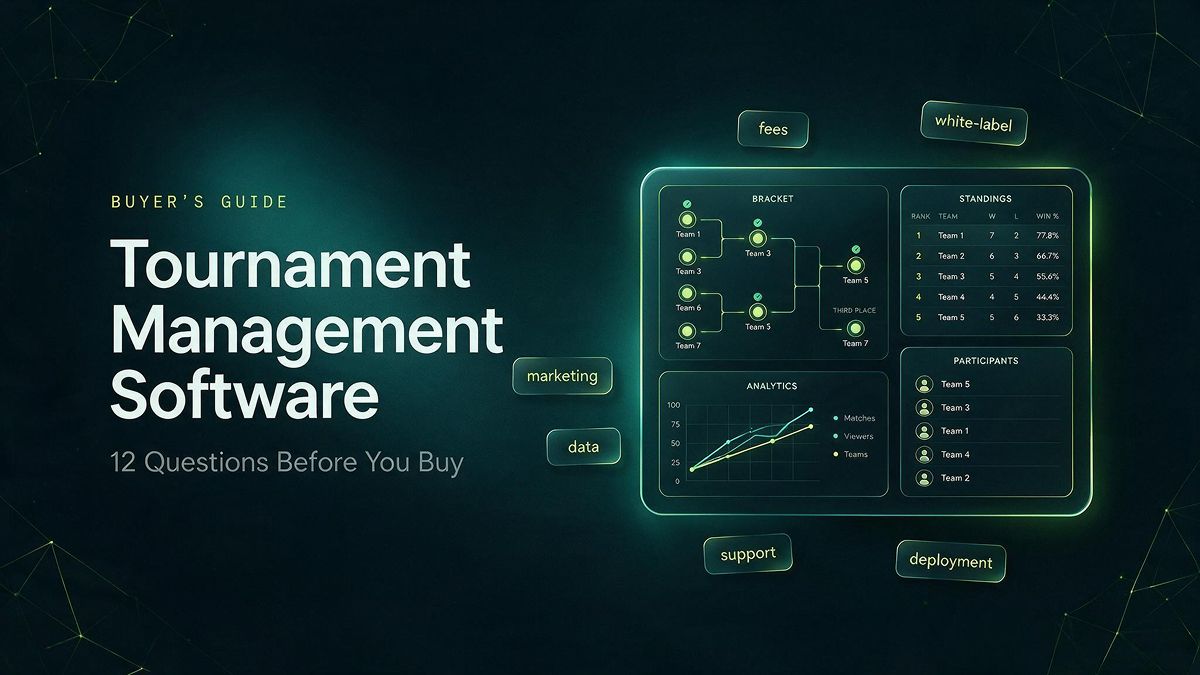
What is tournament management software?
Tournament management software handles registrations, brackets, player accounts, payments, scores, and communication for esports and gaming competitions. Buyers evaluating a white-label competition management platform, tournament management software with white-label capability, or the best white-label bracket solution for tournament engagement should look past raw bracket features. Brand and domain control, player-data terms, pricing, support, and launch time all affect the decision.
A white-label platform lets the buyer operate under its own brand, domain, and colors without a visible "powered by" badge. Netgen's published Essentials plan starts at €699/month, with 0% platform commission and deployment in under 7 days. An indicative market benchmark for a complete custom production platform is €450,000–750,000 over 12–36 months, excluding maintenance, hosting, and support after delivery.
See Netgen's platform example before comparing the questions below.
Many B2B buyers of this software are not gamers themselves. They may work for a club, federation, brand, city, shopping center, or university and need to compare vendors without starting a software project of their own. The questions below focus on price, operating responsibility, brand control, data, and the cost of changing direction later.
Q1: What is included in the monthly price?
A monthly price is useful only when you know what sits behind it. Check user limits, organizer seats, payment features, support, automation credits, setup fees, and annual billing. A low entry price can become difficult to compare if each vendor defines its plan differently.
Netgen publishes three pricing tiers:
- Essentials: €699/month ($849), up to 5,000 users, 0% platform commission, no setup fee, 5M Fluxion AI tokens per month, and a 24-hour response target.
- Premium: €1,499/month ($1,799), up to 10,000 users, integrated payments through Mollie, BitPay, and MamoPay, subscriptions, advertising, four organizer seats, 12M Fluxion AI tokens, an 8-hour response target, and live chat.
- Enterprise: on request, with unlimited users, dedicated hardware, SSO, a custom API, and a 2-hour response target.
Annual billing is published as 11 months paid and one month free. That brings Essentials to €641/month and Premium to €1,374/month. Netgen's published pricing page is a useful reference point, but ask every vendor to confirm what is included in writing.
Q2: Is there a platform commission on my revenue?
A subscription and a transaction fee are different costs. If your program generates revenue, ask whether the platform takes a percentage and whether that percentage applies to registrations, subscriptions, sponsorship-related activity, or another category.
Netgen charges 0% platform commission on revenue generated by the program. Payment processing fees from the selected provider still apply separately. Email, SMS, and WhatsApp delivery fees may also apply depending on the plan and volume.
Ask for a written cost breakdown covering:
- The software subscription
- Platform commission
- Payment processing
- Messaging delivery
- Advertising or subscription features
- Setup, migration, or custom work
"0% platform commission" does not mean that every payment or message is free. It means the platform commission and third-party processing costs should be examined separately.
Q3: How long does deployment actually take?
Deployment time affects the date of your first event. That date may be tied to a sponsor activation, school calendar, federation season, retail campaign, or public program. A feature-rich platform is still a poor choice if it cannot be ready when the event needs to launch.
Netgen's white-label platform is published with deployment in under 7 days. The indicative market benchmark for a custom build is 12–36 months. Those figures describe very different buying decisions.
Ask what the stated timeline includes. Does it cover your domain, branding, organizer access, game configuration, payment setup, testing, and launch support? Also ask what your team must provide before the deployment clock starts. "Fast setup" should refer to a usable, branded platform, not only access to an empty account.
Q4: Can it run under my own brand and domain?
White-label means more than adding a logo to a vendor's page. The buyer should be able to operate the experience under its own brand, domain, and colors, without a visible "powered by" badge.
Check the participant journey from registration to results. Ask whether vendor branding appears in page footers, emails, messages, account areas, or public competition pages. Confirm who controls the domain and which parts of the experience your team can manage.
The published white-label definition covers the buyer's own brand, domain, and colors, with no visible vendor badge. That distinction matters when the tournament is part of a wider sponsorship, community, education, retail, or membership program. The players should understand who operates the competition.
Q5: How are scores validated without manual work?
Manual score review can become a serious workload once an event includes many matches, several games, or multiple days of activity. When comparing platforms, focus on the result: how much checking must organizers still do, and what happens when a submission needs review?
Fluxion AI checks player-submitted screenshots at 99.8% confidence. The goal is to reduce manual score review and keep brackets moving while leaving organizers in control of exceptions and disputes.
Ask vendors to show the player and organizer experience. Check how a result is submitted, how exceptions are handled, how disputes are reviewed, and whether the stated confidence figure applies to the games and event format you plan to use. You do not need a technical explanation to make the buying decision. You need to know whether the process keeps brackets moving and gives organizers control when a result is unusual.
Q6: Which games and languages are supported?
A platform may need to support more than one game over its lifetime. Confirm which titles are available now, how new titles are added, and whether your team can configure them without a new development project.
Netgen's platform is game-agnostic. Listed examples include Fortnite, Rocket League, EA FC, and Valorant, with games added in a few clicks. Support for more than 25 languages is a Netgen-published figure.
Ask which parts of the experience are translated. Registration, rules, notifications, player-facing pages, and organizer tools may not all have the same language coverage. A "25+ languages" claim is a useful reference, but your decision should be based on the languages needed by your players, staff, partners, and audience.
Q7: Who owns the player data?
Player data can include account details, contact information, match history, and participation records. Before signing, define who controls it, who can access it, how it can be exported, and what happens when the agreement ends.
Ask for clear answers on:
- Ownership and control
- Export formats and access
- Deletion requests
- Vendor access
- Use for prospecting
- Model training and consent
- GDPR responsibilities
- Access after termination
Netgen's data terms state that player data remains under the buyer's control, is exportable, is never sold or resold, is not used for the vendor's prospecting, and is not used to train models without explicit consent.
Do not accept a general privacy statement as a substitute for contract language. Ask for the export format, delivery time, fees, deletion process, and access available after termination. Request a sample export or a written exit procedure, and confirm that the contract covers the buyer's control of participant data rather than only access during the subscription. Ask specifically about the transition period: how many days of access remain after cancellation, whether player accounts can be exported with history intact, and whether registration lists and match records can be bulk-exported before the contract ends.
Q8: What does marketing automation cost on top?
Registrations and brackets are only part of running a recurring competition. You may also need confirmations, reminders, schedule changes, results notifications, sponsor messages, and post-event follow-up.
Ask whether those functions are included in the tournament platform or require another subscription. Netgen's plans include marketing automation capabilities such as email, SMS, WhatsApp, in-app messaging, segmentation, and A/B testing. Included volumes should be checked against the selected plan.
Map your expected communication program to the vendor's pricing. Confirm which channels are included, what volume limits apply, and whether email, SMS, or WhatsApp delivery fees remain separate. A platform can include the automation functions while third-party providers still charge for delivery.
Q9: How do five-year costs compare between a white-label platform and a custom build?
The monthly subscription is only one side of a build-versus-buy comparison. A custom project also requires a budget for the initial product, then maintenance, hosting, support, security, and product changes after delivery.
The indicative market benchmark for the custom build is:
- Limited first production version: €300,000–450,000
- Complete platform: €450,000–750,000
- Enterprise scope: €750,000 or more
The indicative market benchmark for the complete platform covers tournaments, payments, marketing automation, AI, robust multi-tenant operation, security, observability, a 99.9% target uptime, more than 25 languages, and APIs. The timeline is 12–36 months. Maintenance, hosting, and support after delivery are not included.
The five-year comparison totals approximately €38,000–42,000, including product evolution, maintenance, and support. The €38,000–42,000 figure is a five-year white-label model that includes evolution, maintenance, and support, whereas €450,000–750,000 is a custom initial-build model that excludes maintenance, hosting, and support after delivery. These are directional figures from different cost models, not like-for-like quotes: one is the cost of operating a published plan, the other an initial-build benchmark that excludes post-delivery operating costs.
Use these figures as an indicative market benchmark, not as a quote for every project. Include internal staffing, infrastructure, delayed launch, and post-launch operations in your own calculation.
Q10: What happens after launch?
Launch is when the operating model becomes real. Ask who hosts the platform, who handles incidents, who maintains it, how updates are managed, and what happens when organizers need help during a live event.
Hosting is available in non-GAFAM, ISO 27001-certified datacenters across the EU, US, and Asia, depending on deployment requirements. The target uptime is 99.9%, with GDPR compliance. Netgen's five-year white-label comparison includes product evolution, maintenance, and support.
Ask vendors to specify:
- Hosting locations
- Security certifications
- Uptime target and measurement
- Maintenance responsibilities
- Product updates
- Support coverage
- Event-day escalation
- Data export and contract exit
The published Les Grands Prés case study records 26 days of EA FC 26 and Rocket League tournaments, approximately 2,400 matches, and 839 hours of gameplay.
Q11: What do the support SLAs actually guarantee?
Support language is easy to misunderstand. A response target is not necessarily a resolution target, and live chat does not explain how a serious incident is escalated.
Ask what each support number means, which channels it covers, and whether it applies during the hours when your tournaments are live. Clarify how the vendor defines a critical incident and whether uptime commitments are separate from support commitments.
Netgen's plan examples list a 24-hour response target for Essentials, an 8-hour response target plus live chat for Premium, and a 2-hour response target for Enterprise. These are published support figures, not necessarily contractual resolution guarantees. Before signing, require the vendor to define response and resolution targets, coverage during live events, critical-incident escalation, uptime measurement, and any remedy for missed commitments.
Treat those figures as a starting point for contract review. Ask whether they are response windows or resolution windows, and what happens when the vendor misses one.
Q12: What questions are vendors not answering?
Missing information is part of the buying decision. If a vendor does not publish a field, do not fill the gap with an assumption. Record it as "not publicly documented" and ask for a written answer.
Use the same comparison fields for every vendor:
- Monthly price and annual billing
- Platform commission
- Payment processing
- User and organizer limits
- White-label branding and domain
- Game and language coverage
- Data ownership and export
- Marketing automation volumes
- Hosting and uptime
- Support response times
- Maintenance and contract exit
- Five-year total cost
White-label platforms versus tournament SaaS
Free tournament management software may be suitable for a small community event or a competition that runs inside an existing service. Paid tournament SaaS becomes more relevant when an organizer needs greater scale, support, or operational features. A premium white-label platform goes further when the buyer also needs its own brand and domain, stronger control over participant data, integrated payments and marketing, and the ability to customize and evolve the platform over time. A custom build provides maximum control, but requires substantially more development time, budget, maintenance, and internal or contracted technical resources.
Compare the four models using the same operational and commercial criteria.
| Field | Free / community tool | Paid tournament SaaS | Premium white-label platform | Custom build |
|---|---|---|---|---|
| Own brand and domain | Unavailable | Limited or partial | Fully available | Fully customizable |
| Participant limits | Often limited | Usually plan-based | Plan-based or high-volume | Depends on infrastructure and scope |
| Data export | Usually unavailable | Usually unavailable or plan-dependent | Available with strong data-control options | Defined by the implementation |
| Platform commission | Usually none | Depends on vendor and payment options | Depends on vendor; Netgen publishes 0% | No platform commission; payment processing costs may still apply |
| Support | Community or self-service | Standard vendor support | Higher-touch support and SLA options | Internal team or contracted support |
| Deployment time | Minutes to hours | Hours to days | Days, with custom iterations afterward | Months to years |
| Customization | Low | Low | High, with custom development possible after launch | Very high |
| Maintenance | Vendor / community | Vendor | Vendor, including platform evolution | Buyer or development partner |
| Five-year cost | Very low | Low to medium | Medium | High to very high |
See the Netgen versus Toornament comparison for another reference point. Then ask each vendor the same questions.
Tournament management software buying checklist
Before choosing a platform, confirm each item in writing:
- What does the monthly plan include?
- Are setup fees, platform commissions, payment fees, or messaging fees separate?
- Which user limits and organizer-seat limits apply?
- How quickly can the platform be deployed?
- Can the program use its own brand, colors, and domain?
- Which games and languages are available at launch?
- How are scores validated, and how are disputed results handled?
- Who controls, exports, and deletes player data?
- Which marketing channels and message volumes are included?
- Where is the platform hosted, and what uptime target applies?
- What do the support response windows actually mean?
- What is the five-year cost compared with building and maintaining the platform?
The right choice is the platform whose price, timeline, data terms, support model, and operating responsibilities are clear enough to compare. A long feature list cannot compensate for missing answers.
If you want to compare the published assumptions with your own program size and launch plan, Calculate your ROI with our team.
FAQ
What is tournament management software?
Tournament management software helps organizations run esports and gaming competitions, including registrations, brackets, player accounts, payments, scores, and communication. A white-label platform lets the buyer operate under its own brand, domain, and colors without a visible "powered by" badge.
How much does tournament management software cost?
Netgen's Essentials plan costs €699/month ($849), or €641/month with annual billing. A complete custom production platform is benchmarked at €450,000–750,000 over 12–36 months, excluding maintenance, hosting, and support after delivery.
What is a white-label esports platform?
A white-label esports platform lets a club, federation, brand, city, shopping center, or university operate a tournament service under its own brand, domain, and colors without a visible "powered by" badge.
Does tournament software take a commission on revenue?
It depends on the vendor and payment model. Some platforms charge a commission on registrations or transactions, while others rely primarily on subscription pricing. Netgen charges 0% platform commission; payment-processing fees from the selected payment provider still apply, and messaging delivery fees may depend on the plan and volume.
How long does white-label tournament software take to deploy?
Deployment time varies by platform and scope. Netgen's white-label platform can be deployed in under 7 days, while a complete custom-built platform typically requires a much longer development cycle.
Who owns the player data?
Player-data terms vary by vendor. Netgen's published terms state that player data remains under the buyer's control, is exportable, is never sold or resold, is not used for Netgen's prospecting, and is not used to train models without explicit consent.

Loïc Fouriau — Founder
Loïc started Netgen in 2019 to build esports infrastructure with the same reliability as enterprise software. He leads every platform project directly and shows up on-site for productions and events, from the initial brief to the final broadcast.